
Subtotal $0.00
Quick answer:
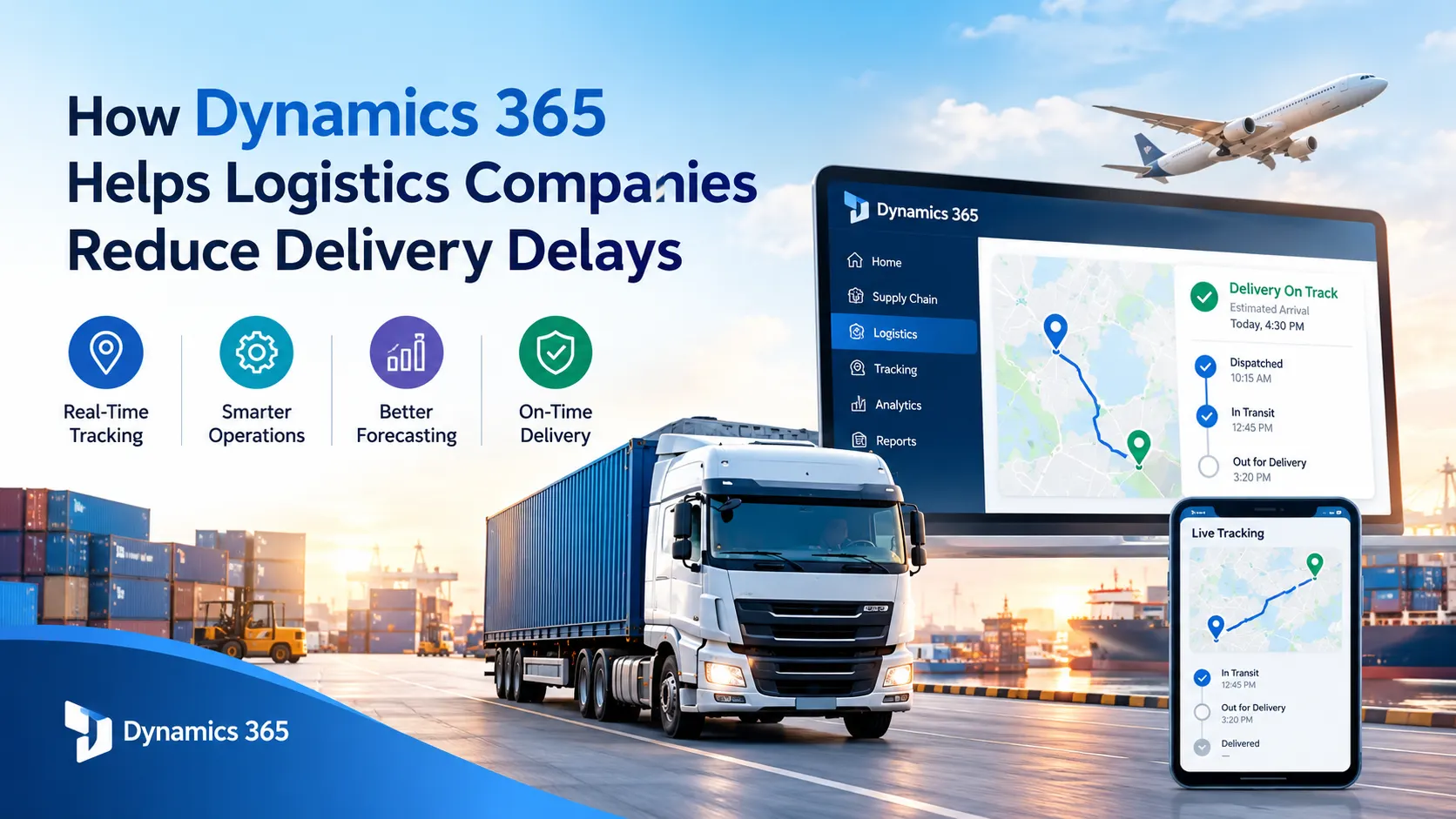
Dynamics 365 Supply Chain Management helps logistics companies reduce delivery delays by connecting warehouse, transport, inventory, supplier, and order data in one cloud platform. It uses AI and Copilot to flag disruption early, automates supplier follow-ups and carrier selection, and gives dispatchers a real-time view so late deliveries are prevented, not just reported.
Key takeaways
- Delays usually start upstream (late suppliers, slow warehouse picks, poor carrier choice), so fixing them needs one connected system.
- Dynamics 365 combines warehouse management (WMS), transportation management (TMS), demand planning, and AI agents.
- Copilot flags weather, geopolitical, and supplier risks and drafts the supplier emails needed to re-plan arrival times.
- Phased rollout is possible, so you do not need to replace every system at once.
- Trident Info UK implements and supports Dynamics 365 for logistics teams in the UK.
Why are UK deliveries delayed so often?
UK delivery delays come from capacity shortages, peak-season demand, weather, poor visibility, and late customer communication. Most of these can be detected earlier than they currently are.
The evidence from recent UK research is consistent:
- According to a Sendcloud survey of around 1,000 UK online shoppers, reported by Parcel and Postal Technology International, 41% said their latest order was delayed, 71% had a negative delivery experience in the prior three months, and 22% were never warned of a delay.
- Esendex’s Delivery Delays Report, built on Indeed data and reported by Parcel and Postal Technology International, counted over 11,000 open HGV driver vacancies and 13,000 delivery driver vacancies, putting peak-season capacity at risk.
- Shipup research on UK peak periods, reported by CXM World, found the average UK delivery took about 4.5 days, while 90% of consumers expected two to three.
- Doddle research, also reported by Parcel and Postal Technology International, found that late arrival was the most common problem during a disrupted December, affecting 41% of UK online shoppers.
The common thread is a visibility gap. A Quisitive and Microsoft webinar reported that 77% of supply chain leaders call real-time visibility essential, yet only 25% have achieved it.
What is Dynamics 365 Supply Chain Management?
Dynamics 365 Supply Chain Management (SCM) is Microsoft’s cloud ERP application for managing procurement, warehousing, transportation, inventory, production, and demand planning in a single platform. According to Evincible Solutions’ implementation guide, it connects procurement, production, warehousing, transportation, and customer fulfillment with a warehouse module covering directed put-away and pick strategies and a transportation module covering carrier selection, load planning, and freight costing.
For logistics companies, the value is integration. As CloudThat explains, the platform ties warehouse and transportation workflows together and can add IoT and AI for predictive operations.
How does Dynamics 365 reduce delivery delays?
1. It gives dispatchers one real-time view: According to Evincible Solutions, Dynamics 365 provides real-time visibility from supplier shipments and warehouse inventory through order fulfillment and delivery. When warehouse, transport, and order data sit in one system, a late inbound pallet is visible to the dispatcher before the customer calls.
2. It automates supplier follow-ups: Microsoft describes supplier communications. Agent that manages supplier communications autonomously to confirm delivery and address risks before they cause delays. Chasing suppliers by email is a classic hidden source of delay; automating it frees planners for exceptions.
3. Copilot flags disruption early and drafts the response: Velosio reports that Copilot in the Microsoft Supply Chain Center uses news signals to flag external issues such as weather and financial and geopolitical events. Intelegain adds that it highlights affected orders across materials, inventory, carriers, and distribution networks and generates contextual emails so managers can confirm new ETAs and reroute purchase orders.
4. It optimises carrier selection and load planning: Transportation management automates carrier choice, load building, and freight costing, which CloudThat says reduces freight cost and improves delivery performance. Using multiple carriers also gives you somewhere to switch when a network is congested, a tactic SendCloud is recommended for UK retailers, as reported by Internet Retailing.
5. It speeds up warehouse throughput: Warehouse management applies directed put-away, pick strategies, and mobile-device workflows so stock is found and dispatched faster. Microsoft also describes intelligent on-hand balancing that updates slotting to align demand with pick zones.
6. It improves forecasting and order promising: Microsoft says demand planning can combine external signals such as demand shifts, promotions, and market conditions with operational data to continuously adjust forecasts, and that connected data helps order promising reflect current conditions, reducing overpromising. Broader industry analysis, such as Fast.io’s 2026 supply chain AI guide, cites McKinsey figures that AI forecasting can cut errors by 20 to 50 percent (a secondary report, so verify the original before quoting it as your own claim).
7. It runs planning in minutes, not hours: Microsoft states that complete MRP runs finish in minutes, so planners can react to demand changes in near real time. Faster replanning shortens the gap between a disruption and a corrected delivery promise.
Where do delays happen and what fixes them?
| Delay causes | Dynamics 365 capability | Result |
|---|---|---|
| Late or silent suppliers | Supplier Communications Agent, Copilot disruption alerts | Risks surface, and ETAs are confirmed earlier. |
| Slow warehouse picking | Warehouse management, directed put-away, mobile workflows | Faster, more accurate dispatch |
| Poor carrier or route choice | Transportation management, carrier selection, load planning | Better on-time performance and lower freight cost |
| Surprise demand spikes | Demand planning with external signals | Capacity and stock match demand sooner. |
| Customers uninformed | Customer and vendor portals, real-time status | Fewer “Where is my order?” contacts |
| Weather or geopolitical events | Copilot news-based risk flags | Re-routing before the delay lands |
What is the role of AI agents in 2026?
AI agents are moving from suggesting actions to carrying them out inside governed workflows. Microsoft says Dynamics 365 and Microsoft 365 Copilot let agents work across data and business processes in a governed way, and it announced the Procurement Agent in Dynamics 365 Supply Chain Management in public preview. One customer, Farmlands Cooperative, expects Dynamics 365 to save its team 20 hours a week.
Analysts expect the trend to continue. A 2026 AI Buzz industry roundup reports a Gartner prediction that 60% of supply chain disruptions will be resolved without human intervention by 2031, and Supply Chain Management Review notes a June 2025 The Gartner survey found only 23% of supply chain leaders had a formal AI strategy. The opportunity for early adopters is clear, as is the need for a plan.
How should a logistics company roll out Dynamics 365?
- Baseline your delays. Measure on-time-in-full (OTIF), average delay length, and top causes by lane, carrier, and supplier.
- Pick one decision domain. Start with the costliest: supplier lateness, warehouse dispatch, or carrier performance.
- Phase the rollout. Microsoft notes you can modernise in phases without ripping and replacing everything at once.
- Connect data first, then add AI. Copilot and agents are only as good as the warehouse, transport and supplier data beneath them.
- Govern and measure. Track OTIF, delay minutes, claims, and customer contacts monthly.
Trident Info UK helps UK logistics teams with each step, from discovery and configuration to integration, training, and ongoing support.
Frequently asked questions
Q1. What is Dynamics 365 used for in logistics?
Ans: It manages warehousing, transportation, inventory, procurement, and planning in one cloud platform so logistics teams can see and control the full flow from supplier to customer.
Q2. Can Dynamics 365 reduce late deliveries?
Ans: Yes, by giving earlier visibility, automating supplier and carrier workflows, and using AI to flag disruption and re-plan. Results depend on data quality, process design and adoption.
Q3. Does Dynamics 365 include transportation management?
Ans: Yes. Dynamics 365 Supply Chain Management includes transportation management for carrier selection, load planning, and freight costing.
Q4. What does Copilot do in Dynamics 365 Supply Chain Management?
Ans: Copilot in Microsoft Supply Chain Center flags external risks, identifies impacted orders, and drafts supplier emails to confirm new ETAs.
Q5. Do we have to replace our existing systems?
Ans: No. Microsoft positions Dynamics 365 for phased modernisation, and integrations can connect existing TMS, WMS, carrier, and customer systems.
Q6. How long does implementation take?
Ans: It depends on scope, number of sites, and integrations. A focused first phase (one warehouse or one decision domain) is typically scoped separately from a multi-site rollout. Trident Info UK can give a timeline after a discovery session.
Q7. Is Dynamics 365 suitable for small and mid-sized logistics firms?
Ans: Yes. Because modules can be adopted in phases, mid-sized firms can start with the highest-impact area and expand.
Next step
Want to find out where your delivery delays start? Book a free Dynamics 365 logistics discovery call with Trident Info UK. We will map your delay causes and show where Dynamics 365 would help first.
Comments are closed