
Subtotal $0.00
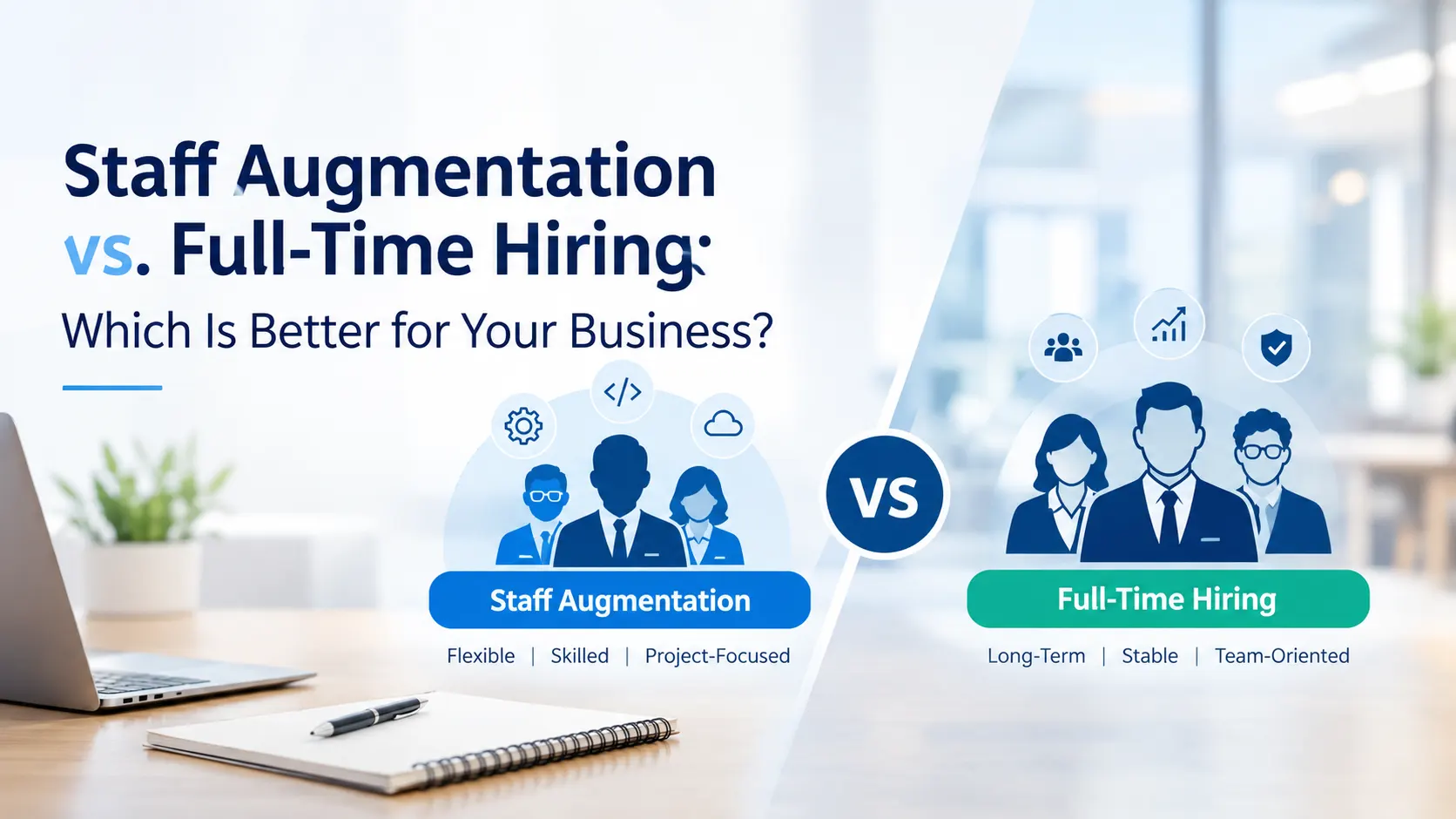
Businesses today need the right talent to manage projects, adopt new technologies, and achieve growth without exceeding their budgets. However, deciding whether to hire full-time employees or use staff augmentation services can be challenging. Both hiring models offer advantages, but the right choice depends on your project requirements, budget, skills gaps, and long-term business goals.
Staff augmentation is generally better for businesses that need specialised skills, flexible resources, or temporary project support. Full-time hiring is often better for permanent roles that require long-term ownership, organisational knowledge, and consistent involvement. Many businesses achieve the best results by combining both approaches.
In this guide, Trident Info UK explains the differences between staff augmentation and full-time hiring, including their costs, benefits, limitations, and practical use cases.
What Is Staff Augmentation?
Staff augmentation is a workforce model in which a business brings in external professionals to supplement its existing team. These professionals work alongside internal employees and help address skill shortages, meet project deadlines, or manage increased workloads.
Unlike traditional outsourcing, staff augmentation usually allows the business to retain day-to-day control over tasks, priorities, and project delivery.
For example, a company implementing Microsoft Dynamics 365 Business Central might already have an internal IT team but lack experienced ERP developers or functional consultants. Instead of hiring permanent employees for a temporary need, the company can engage qualified specialists through a staff augmentation partner.
Key Benefits of Staff Augmentation
- Access to specialised skills: Bring in professionals with relevant technical or industry experience.
- Flexible workforce planning: Increase or reduce team capacity according to project requirements and contract terms.
- Faster access to talent: Avoid running an entire internal recruitment process when suitable specialists are available.
- Reduced recruitment administration: A staffing partner can manage candidate sourcing and initial screening.
- Project-focused support: Add resources for ERP implementations, system upgrades, integrations, migrations, and testing.
However, staff augmentation is not automatically cheaper than permanent hiring. Hourly or monthly rates may be higher than an employee’s equivalent base pay, and the business must still account for onboarding, supervision, security, and contract management.
What Is Full-Time Hiring?
Full-time hiring involves recruiting employees directly into permanent or ongoing positions within your organisation. The employer manages recruitment, salary, benefits, onboarding, performance reviews, and employee development.
This approach works well when a business requires consistent expertise, long-term collaboration, and employees who develop a deep understanding of its products, processes, and customers.
For instance, a company that needs an internal ERP administrator to maintain business systems, coordinate departments, and manage ongoing improvements may benefit from hiring a full-time employee.
Key Benefits of Full-Time Hiring
- Long-term team stability: Employees develop relationships and build knowledge of internal business processes.
- Consistent ownership: Permanent team members can take responsibility for ongoing operations and strategic initiatives.
- Stronger organisational integration: Employees can participate in company culture, training, and career development.
- Knowledge retention: Experienced employees can preserve important business and technical knowledge.
- Predictable team structure: Permanent roles help establish stable reporting lines and responsibilities.
The main challenges include recruitment time, employment costs, onboarding requirements, and the commitment to maintain the role even when project demand changes.
Staff Augmentation vs Full-Time Hiring: Key Differences
The following table summarises the main differences between the two workforce models.
| Comparison factor | Staff augmentation | Full-time hiring |
|---|---|---|
| Employment arrangement | External professional supplied through a staffing partner | Employee hired directly by the business |
| Engagement period | Often project-based or contract-based | Usually ongoing |
| Access to expertise | Useful for specialised or hard-to-find skills | Suitable for developing permanent internal capabilities |
| Recruitment process | Sourcing and screening may be handled by a provider | Managed by the employer or its recruitment partner |
| Cost structure | Contractual hourly, daily, or monthly rate | Salary, benefits, employer costs, and recruitment expenses |
| Workforce flexibility | Generally easier to adjust within contract terms | Changes may require a new recruitment process or employment procedures |
| Management | Usually directed by the client’s project or technical team | Managed through the organisation’s normal structure |
| Knowledge retention | Requires deliberate documentation and handover | Supports continuity through long-term employment |
| Best suited for | Temporary workloads, project delivery, specialist support | Permanent responsibilities and ongoing business operations |
The most important difference is not simply how professionals are hired. It is how long the business needs their expertise and how much ongoing responsibility the role requires.
Which Hiring Model Is More Cost-Effective?
The answer depends on the total cost of obtaining the skills your business needs, rather than salary or hourly rates alone.
Understanding the Cost of Staff Augmentation
Staff augmentation typically involves an agreed contractual rate. Depending on the provider and contract, this rate may cover professional compensation, recruitment, employment administration, and other associated costs.
Additional expenses can include:
- Project onboarding and training.
- Management and coordination.
- Software licenses and equipment.
- Knowledge transfer and documentation.
- Contract extensions or specialist replacement.
For a project lasting a few months, staff augmentation may help avoid the time and expense of establishing a permanent role that will no longer be needed after delivery.
Understanding the Cost of Full-Time Hiring
Full-time employees involve more than their advertised salary. Employers may also need to budget for recruitment, benefits, payroll-related costs, equipment, training, and management time.
The Society for Human Resource Management (SHRM) reported in an April 2022 article that its benchmarking data placed average cost per hire at nearly $4,700. The same article noted that some employers estimate total hiring costs at three to four times the position’s salary, although actual costs vary significantly by role and organisation.
Businesses should therefore compare the full cost of each option over the expected engagement period. Staff augmentation can be cost-effective for short-term or variable workloads, while direct employment may provide better value for a consistently required role over several years.
Cost-saving tip: Compare total expected expenditure, productive hours, recruitment time, utilisation, and the cost of retaining or replacing expertise before choosing a hiring model.
When Should You Choose Staff Augmentation?
Staff augmentation is worth considering when your business needs additional skills or delivery capacity without immediately expanding its permanent workforce.
It may be the better option in the following situations:
1. You have a time-sensitive project: If a project has a defined deadline, additional professionals can help increase capacity and distribute work more effectively.
2. Your internal team lacks specialist expertise: You may need experienced ERP consultants, developers, solution architects, data migration specialists, or software testers for a particular initiative.
3. You are implementing or upgrading an ERP system: Projects involving Microsoft Dynamics 365 Business Central or Dynamics 365 Finance and Operations can require different skills at different stages, from discovery and configuration to migration, testing, and deployment.
4. Your workload changes throughout the year: Businesses experiencing seasonal demand, temporary backlogs, or fluctuating project pipelines may benefit from a more adaptable workforce.
5. You need to fill a skills gap quickly: External specialists can complement an existing team while the business develops its long-term recruitment and training plans.
SHRM’s discussion of contingent workers also highlights their potential benefits, including access to specialised talent and workforce flexibility. However, the suitability of this approach depends on the job, the worker arrangement, and how effectively the engagement is managed.
When Is Full-Time Hiring the Better Choice?
Full-time hiring is often the stronger option when a role is essential to your business and the required work is expected to continue indefinitely.
Consider permanent hiring when:
- The role is central to daily operations. Your business needs consistent ownership of essential systems, processes, or customer relationships.
- Long-term knowledge is important. The employee must understand complex internal workflows, historical decisions, and business-specific requirements.
- You need continuous collaboration. The position involves close coordination with several departments and long-term team development.
- The workload is stable. You have enough ongoing work to justify a permanent position.
- You want to develop internal capabilities. Employees can grow into leadership roles and support future business initiatives.
For example, a company that continuously manages its ERP environment may benefit from a permanent internal system owner, even if it uses external specialists for major upgrades or complex integrations.
Staff Augmentation vs Full-Time Hiring for Microsoft Dynamics 365 Projects
Choosing the right workforce model becomes particularly important during ERP implementation and transformation projects.
Microsoft Dynamics 365 projects can involve business analysts, functional consultants, technical developers, solution architects, integration specialists, and data migration professionals. The required team composition often changes as the project progresses.
Staff augmentation can help businesses bring in additional specialists for specific phases, such as:
- Dynamics 365 Business Central implementation.
- Microsoft Dynamics NAV to Business Central migration.
- Dynamics 365 Finance and Operations configuration.
- Data migration, validation, and testing.
- Customisation and third-party integrations.
- Post-go-live support and system optimisation.
Full-time employees can maintain internal ownership, coordinate business users, oversee system governance, and manage ongoing operations.
For many organisations, a hybrid approach works well: permanent employees retain responsibility for business-critical operations, while external specialists provide additional expertise during demanding project phases.
Trident Info UK’s ERP services focus on Microsoft Dynamics solutions, including implementation, migration, customisation, and support. Businesses evaluating additional project resources should define the required skills, delivery responsibilities, engagement period, and expected outcomes before selecting a staffing arrangement.
How to Choose the Right Hiring Model for Your Business
Before making a decision, ask these five questions:
- How long will you need the skills? Short-term requirements may favour augmentation, while permanent responsibilities may justify direct hiring.
- How specialised is the work? Niche technical requirements may be easier to address through an experienced staffing partner.
- What is your total budget? Compare all relevant employment, contract, onboarding, management, and replacement costs.
- How much control and continuity do you need? Consider project ownership, knowledge retention, and the importance of long-term collaboration.
- Can your current team manage the additional resources? Staff augmentation works best when internal managers can provide direction, feedback, access, and clear priorities.
The answers will help you evaluate each role individually instead of assuming that one hiring model is always better.
Conclusion: Which Is Better for Your Business?
Staff augmentation is generally suitable for flexible staffing needs, specialised expertise, and time-bound projects. Full-time hiring is often better for permanent responsibilities, long-term knowledge retention, and stable business operations.
Neither approach is universally superior. The right decision depends on your project duration, skills requirements, budget, and need for long-term team continuity.
For Microsoft Dynamics 365 implementation, migration, development, and support projects, combining a permanent internal team with additional specialist resources can provide a practical balance between continuity and flexibility.
Trident Info UK helps businesses explore Microsoft Dynamics ERP implementation, migration, customisation, and support requirements. If your business needs flexible access to skilled professionals, choosing the right staff augmentation partner in the UK can help address resource gaps, support project delivery, and align technical expertise with your business goals.
Frequently Asked Questions
Q1. What is the difference between staff augmentation and full-time hiring?
Ans: Staff augmentation adds external professionals to an existing team for an agreed engagement period. Full-time hiring involves recruiting employees directly for ongoing roles. Staff augmentation prioritises flexibility, while full-time hiring supports long-term ownership and continuity.
Q2. Is staff augmentation cheaper than full-time hiring?
Ans: Staff augmentation can be more cost-effective for short-term projects and specialised requirements because it may reduce recruitment and ongoing employment administration. However, its rates can be higher than an employee’s base salary. Compare total costs over the expected engagement period before deciding.
Q3. When should a business use staff augmentation?
Ans: A business should consider staff augmentation when it needs specialist skills, additional project capacity, temporary technical support, or resources for an ERP implementation, software upgrade, data migration, or integration project.
Q4. What are the disadvantages of staff augmentation?
Ans: Potential disadvantages include provider dependency, contractual costs, onboarding requirements, security considerations, and the need to document business knowledge. External professionals also require clear management and communication to work effectively with internal teams.
Q5. Is full-time hiring better for long-term projects?
Ans: Full-time hiring can be a better fit when work is continuous, the role is business-critical, and long-term organisational knowledge is important. Nevertheless, staff augmentation may remain useful for specialist tasks within a long-running project.
Q6. Can staff augmentation and full-time hiring work together?
Ans: Yes. Businesses can retain permanent employees for core responsibilities and use external specialists to address temporary skills gaps or project workloads. This hybrid approach can balance continuity with workforce flexibility.
Q7. How does staff augmentation help with Microsoft Dynamics 365 implementation?
Ans: Staff augmentation can provide access to functional consultants, developers, solution architects, data migration specialists, and testers. These professionals can supplement an internal team during implementation, customisation, integration, testing, and deployment.
Q8. How should businesses evaluate a staff augmentation provider?
Ans: Evaluate technical expertise, relevant project experience, candidate screening, communication, security practices, contract terms, replacement procedures, and the provider’s ability to supply suitable professionals when needed.
Comments are closed